Pokémon Card Values: 3 Tools for Precise Market Data
If you have ever tried to appraise a childhood binder or a newly acquired booster box, you have likely run into the same frustrating discrepancy: seeing a card listed on eBay for $5,000, only to discover the last actual sale was for $45.
The Pokémon card market has evolved from a nostalgic hobby into a highly sophisticated alternative asset class. High-volume flippers, alternative asset managers, and serious collectors no longer rely on guesswork, outdated price guides, or inflated asking prices. Instead, they require granular, real-time data to track their portfolios, calculate grading ROI, and identify market inefficiencies before the broader public catches on.
Whether you are hunting for vintage grails, grading modern alternate arts, or simply organizing your inventory, navigating this ecosystem requires specialized utilities. This guide breaks down how to calculate true market values, categorize your sets, and leverage three specific tools to Track Pokemon Cards Value in Real-Time (2026 Tools).
QUICK JUMP To Pokemon Card Sets

If you are looking to appraise a specific era of your collection quickly, use this categorization matrix to understand which market datasets apply to your cards.
| Era / Category | Notable Sets | Primary Value Drivers | Liquidity Level |
|---|---|---|---|
| Vintage WOTC (1999-2003) | Base Set, Jungle, Fossil, Neo Genesis | Condition, 1st Edition Stamps, Nostalgia | High (for graded items) |
| Mid-Era (2004-2010) | EX Deoxys, Diamond & Pearl, HeartGold & SoulSilver | Scarcity, Pull Rates, Low Pop Reports | Medium-Low (niche buyers) |
| Modern (2011-2019) | Black & White, XY Evolutions, Sun & Moon | Alternate Arts, Secret Rares, Meta Playability | High |
| Ultra-Modern (2020-Present) | Evolving Skies, 151, Paldea Evolved | Chaser Cards, Waifu Cards, FOMO | Extremely High |
What's Your Pokemon Card Collection Worth?
Understanding the worth of your collection requires separating theoretical value from liquid value. A binder full of bulk holos might have a cumulative database value of $500, but realizing that cash requires selling them individually, accounting for shipping, platform fees, and time.
When calculating the worth of expensive pokemon cards, professionals use a three-tiered valuation framework:
- Raw Market Average: The median price a card sells for in ungraded, "Near Mint" condition.
- Graded Premium: The price multiplier applied when a card is encapsulated and authenticated by PSA, CGC, or BGS. A PSA 10 often commands a 5x to 10x premium over a raw copy.
- Liquidity Discount: The percentage you must deduct if you need to liquidate an asset quickly (often selling to a dealer at 60-70% of market value rather than waiting for an end buyer).
3 Essential Tools for Real-Time Pokemon Card Valuation
To bridge the gap between asking prices and reality, investors use a combination of aggregator databases, AI-driven analytics, and portfolio management hubs.
1. TCGPlayer (The Raw Card Standard)
For sheer transaction volume on raw (ungraded) cards, TCGPlayer is the bedrock of the North American market. Local game stores and individual sellers use this platform to move massive quantities of inventory.
Their Pokemon Price Guides are the industry standard for determining the "Market Price" of a raw card. The platform's algorithm calculates this by averaging recent completed sales, smoothing out outlier data. If you are flipping modern sets or bulk, this is your baseline. However, TCGPlayer is less reliable for high-end graded vintage, as those buyers typically gravitate toward auction houses or specialized marketplaces.
2. PriceCharting & Data Aggregators
When you need to look at historical trends across both raw and graded conditions, aggregators like PriceCharting pull realized sales directly from eBay and overlay them with population reports. Their Pokemon Card Prices | PSA & Ungraded Price Guide acts as a visual timeline for asset depreciation or appreciation.
Alternative platforms like PokeDATA - Check Pokemon card values and sealed product ... and the Pokemon TCG Price Guide from Cardhedger provide similar aggregation, focusing heavily on sealed product tracking and AI-driven predictive modeling.
3. PokéInvest (Advanced Portfolio Management & Analytics)
Aggregators are helpful for checking a single card, but managing an alternative asset portfolio requires centralized intelligence. PokéInvest was engineered specifically for serious financial investors and high-volume flippers who treat Pokémon cards like equities.
Rather than manually tracking individual sales across multiple tabs, users leverage PokéInvest to optimize their holdings. Standout tools include:
- The Hidden Gems Score™: A proprietary algorithm that scans the market for under-priced assets by comparing historical velocity, current supply, and population reports.
- PSA Grading ROI Calculator: Before you spend $15 to $40 grading a raw card, this calculator assesses the potential profit margins by comparing the raw acquisition cost, grading fees, and current graded market values across different conditional tiers.
- Oracle AI: A live data assistant that allows users to query specific trends using natural language (e.g., "What is the 30-day value change for alternate arts in Sword & Shield?").
- Custom Price Alerts: Setting automated triggers to notify you of clean eBay deals or market dips on target assets.
Browse Popular Pokemon Card Sets
Card values fluctuate wildly depending on the set's print run, the popularity of the featured Pokémon, and overall market sentiment.
Vintage Heavyweights
The most stable assets in the hobby reside here. Base Set (1999) remains the gold standard, particularly shadowless pokemon cards, which were printed before the standard unlimited run and lack the drop shadow around the character art box. Due to their extreme scarcity and the age of the cardboard, high-grade shadowless variants consistently fetch premium prices at auction.
Moving slightly forward into the EX era, gold star pokemon cards are among the most liquid high-end assets. Featuring shiny variants of popular characters with artwork protruding past the borders, these cards had notoriously brutal pull rates (roughly 1 in 72 packs), making pristine copies incredibly elusive today.
Modern & Ultra-Modern Titans
Modern value is driven by "Alternate Arts" (Alt Arts) and Special Illustration Rares (SIRs). Sets like Evolving Skies commanded massive premiums due to the inclusion of highly sought-after Eeveelution cards featuring complex, full-card artwork. Similarly, the 151 set capitalized on millennial nostalgia by re-imagining the original Kanto Pokédex, resulting in severe supply constraints and immediate price spikes upon release.
New Releases: Pokemon Card Sets
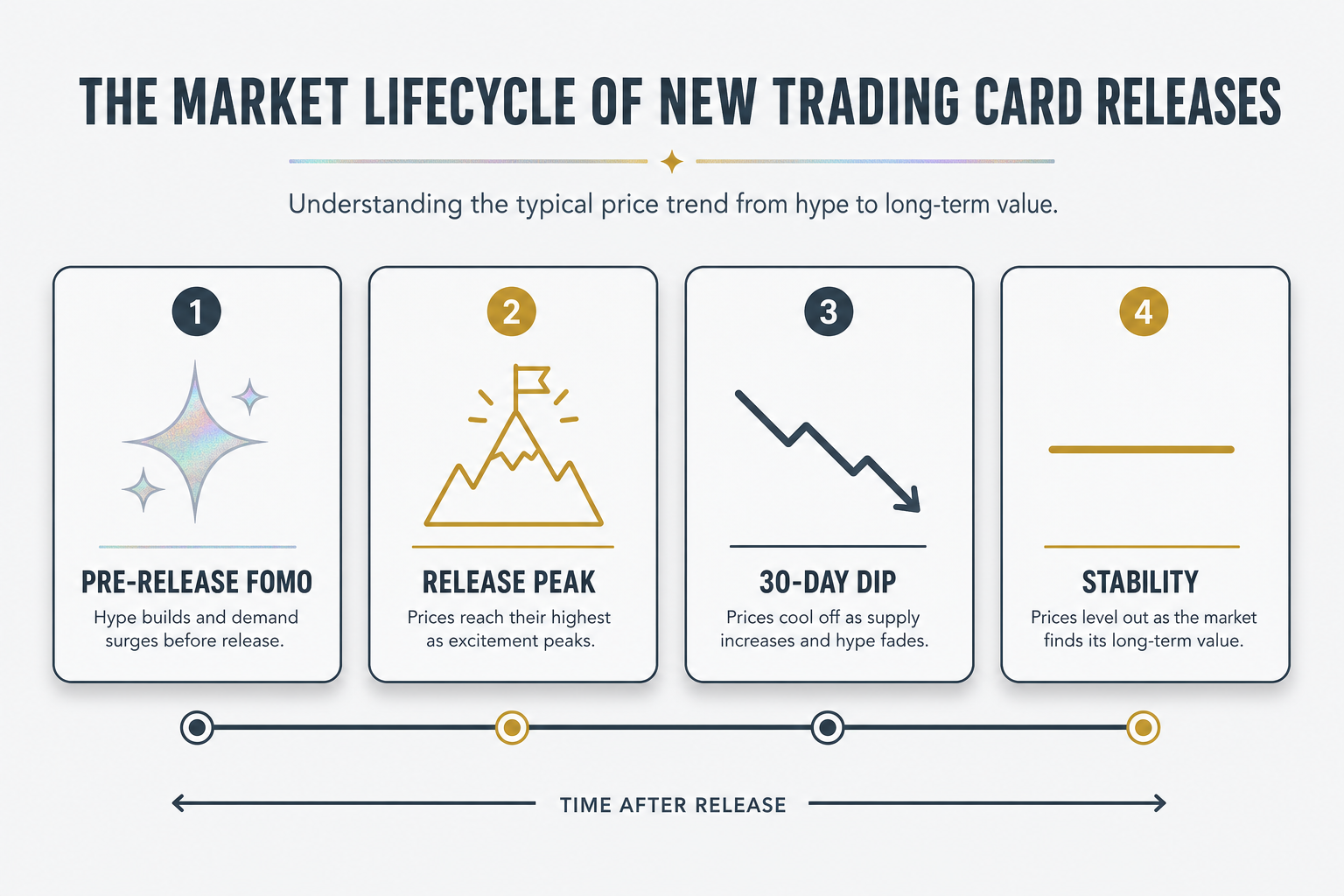
Managing assets from upcoming releases requires a different strategy than holding vintage. When a new set is coming soon, the market experiences a predictable lifecycle:
- Pre-Release FOMO: Prices for unreleased "chaser" cards are speculatively high.
- Release Weekend Peak: Supply hits the market, but demand outstrips it. Prices remain inflated.
- The 30-Day Dip: As more booster boxes are opened and initial hype cools, raw card prices generally drop 30% to 50%.
- The 8-Month Stabilization: The set goes out of print, and the true market floor is established.
Investors actively use community sentiment trackers—often debating the Best Site for Pokemon Card prices : r/PokeInvesting on platforms like Reddit—to time their entry points during the 30-day dip.
How Do We Calculate Pokemon Card Prices?
If you want to understand the mechanics behind the numbers, you must look at how the data is sourced. To see a detailed breakdown of this market psychology, many analysts point to fundamental supply and demand mechanics, as explained in overviews like How Pokémon Card Prices Work.
In practice, calculating a precise price requires checking three distinct data points:
- Last Sold Listings: Asking prices mean nothing. Only completed transactions (eBay Sold, PWCC, Goldin Auctions) dictate value.
- Population Reports: Scarcity drives the premium. A card might be old, but if PSA has graded 15,000 copies in a Gem Mint 10, the ceiling on its value is capped. Conversely, a modern card with known printing defects might have a "low pop" in a PSA 10, driving the price exponentially higher.
- Sales Velocity: How often does the card sell? A card valued at $2,000 that sells once every three years is a highly illiquid asset. A $200 card that sells 15 times a day provides predictable, scalable cash flow.
Self-Appraisal: Spotting Condition Issues Before Grading
The most common mistake casual collectors make is assuming their childhood collection is entirely "Mint" and therefore worth the ceiling prices listed in databases.
To accurately forecast the value of your graded pokemon cards, you must perform a strict self-appraisal before sending anything off to PSA or CGC. Look for these hidden value-killers:
- Centering: Are the yellow or silver borders perfectly even on all four sides? A perfectly clean card with 70/30 centering will never achieve a pristine grade.
- Holo Bleed and Print Lines: Look at the holographic foil under a harsh LED light. Factory print lines (faint, straight lines running across the foil) are incredibly common in modern sets and will severely cap the grade.
- Edgewear and Whitening: Flip the card over to the blue back. Examine the deep blue borders for tiny specks of white. Even one microscopic white dot takes the card out of Gem Mint contention.
- Surface Scratches: Nostalgic cards stored in standard 3-ring binders often suffer from micro-scratches caused by dust and friction sliding in and out of the pockets.
By running your self-appraisal assumptions through PokéInvest's PSA Grading ROI Calculator, you can definitively decide whether a card is better sold raw or encapsulated.
Other Card Types & The Broader Collectibles Ecosystem
Investors treating TCGs as alternative assets rarely stop at cardboard. The strategies used to value a Base Set Charizard share an operational DNA with other physical collectibles.
Many high-end portfolio managers track sealed video games alongside their trading cards. The market mechanics are nearly identical whether you are valuing an original sealed Nintendo Gameboy, highly-rated PlayStation and Switch games, or vintage Atari cartridges. In both ecosystems, a third-party grading company (like Wata Games for video games, or PSA for cards) authenticates the seal, verifies the condition, and creates a standardized population report.
Understanding how capital flows between these physical alternative assets provides a macro view of the market. When liquidity is high in retro gaming, it often spills over into premium Pokémon assets.
Next Steps for Portfolio Optimization
Appraising your collection is an ongoing process, not a one-time event. The market is constantly adjusting to new set releases, shifting population reports, and macroeconomic factors.
To move from casually checking prices to actively managing an asset class:
- Digitize Your Inventory: Stop relying on mental math. Input your high-value cards into a centralized portfolio tracker to monitor 30-day value changes.
- Run the ROI Math: Before paying grading fees, use dedicated calculators to ensure the premium justifies the turnaround time.
- Set Strategic Alerts: Identify the specific vintage slabs or modern alternate arts you want to acquire, set your target buy-in price, and let automated alerts notify you when the market dips.
By leveraging aggregated data and predictive analytics, you remove the emotion from buying and selling, ensuring your collection functions as a precision-managed portfolio.
PokéInvest
Pokemon Card Investing
Related Posts

7 Rare Pokemon Cards With High ROI Potential (2026)
Discover 7 rare Pokémon cards with high ROI potential in 2026. Learn how to track values, assess grading profitability, and build a high-yield TCG portfolio.
Read more
7 Signs a Local Card Shop Is Actually Ripping You Off
Discover the 7 red flags of shady local card shops. Learn how to use live market data, evaluate buy-list margins, and protect your trading card investments.
Read more